Agents Become Operational Actors
They perceive, reason, act through tools, and persist across workflows. That changes the relationship between software and the firm.
Executive Companion
What the firm becomes when AI learns to act
A practical executive guide to agentic enterprise design, operating models, risk, people, deployment capability, and competitive advantage.
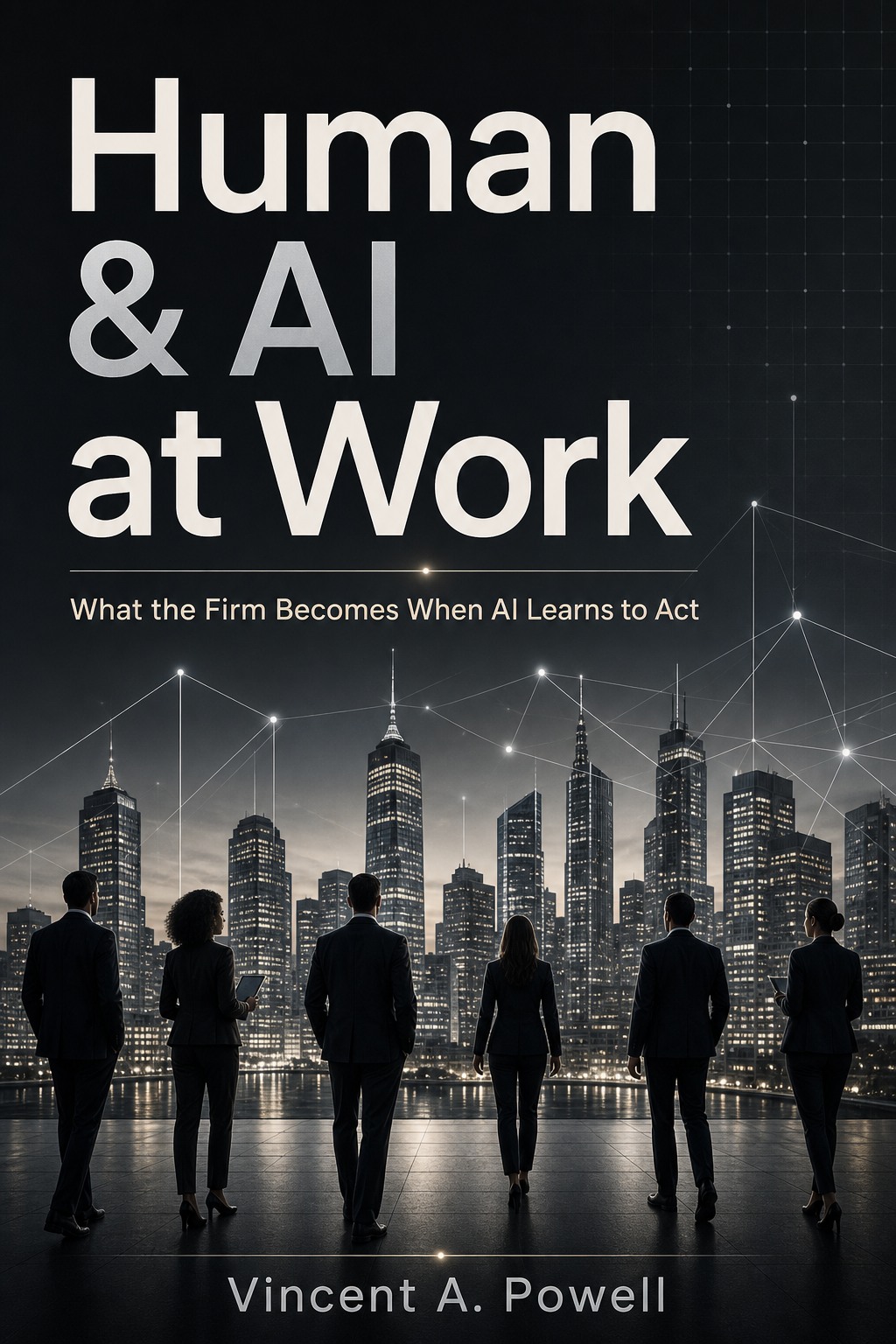
The Premise
Most firms were built around human limits: departments, handoffs, approvals, reporting lines, meetings, and systems of record. As AI agents take on real work, many of those legacy structures and practices stop being necessary in their current form.
When agents can perceive, reason, use tools, and persist across workflows, software becomes an operational actor inside the firm. Coordination costs collapse. Authority has to be redesigned. Risk moves differently. The advantage shifts to firms that can rebuild how work gets done.
The Central Argument
They perceive, reason, act through tools, and persist across workflows. That changes the relationship between software and the firm.
Work moves at machine speed across functions, reducing the need for structures built around human-paced handoffs.
Failure can cascade through systems, vendors, data, permissions, and decisions before a human sees the whole pattern.
The advantage is not automation alone. It is the capacity to learn from execution and improve the operating model continuously.
Inside the Book
Introduces the core shift: firms were built around people as the unit of execution, and agents unsettle that assumption.
Separates chatbots, copilots, and agents by operational character, autonomy, and accountability.
Explains how falling cognitive costs reshape which work remains human and which work becomes agentic.
Shows how machine-speed coordination changes management layers, handoffs, and organisational friction.
Frames the new operating model around workflow execution, supervision, escalation, and learning.
Describes how functions change shape when routine work moves into agentic workflows.
Treats agents as managed operational actors with permissions, monitoring, performance, and retirement.
Explains how specialised agents coordinate across tasks and create new supervisory requirements.
Shows how the firm can learn from its own operational record when agentic systems produce usable memory.
Maps cascading failure, hallucinated operations, shadow automation, bias, and vendor concentration.
Turns from ordinary failure to adversarial risk: prompt injection, exfiltration, and containment.
Examines status, learning, authority, trust, and the hidden spread of individual AI augmentation.
Argues that advantage shifts toward execution intelligence and cumulative operational learning.
Identifies the workflows, data readiness, governance, and learning functions needed to build well.
Connects capital allocation, real options, metrics, and accountability across the transition.
Shows a day inside an agentic firm, where people direct the institution and agents execute much of the flow.
Returns to the leadership question: what kind of institution emerges when intelligence becomes infrastructure?
Provides a structured question set for directors overseeing agentic deployment and organisational change.
Who It Is For
Availability
Published 5 August 2026 by Oblongix Advisory Publishing. ISBN-10: 1919518525. ISBN-13: 9781919518527. eISBN: 9781919518534.

Oblongix Advisory Publishing
Executive transformation
How leaders turn AI ambition into operating-model change, measurable value and retained agency.
Explore the CEO's GuideBoard governance
A practical governance system for boards overseeing strategy, control, people and accountability.
Explore the Board's GuidePublisher catalogue
View the complete series, confirmed editions and publication information.
Visit the publisherBring It Into the Operating Model
Contact Vincent A. Powell for book enquiries, speaking, workshops, advisory support, or board and executive sessions focused on agentic enterprise design.